Hosting
Everything you need to stand the kit up: prerequisites, how scores reach the box, the GitHub OAuth app contestants sign in with, and how event config reaches the app. For the happy-path command sequence see the README Quickstart; for running the event once it is up see docs/operations.md.
Quickstart: zero to a scored event
The fastest path is the wizard — run ctf-setup.sh with no subcommand and
it walks the whole sequence below. It asks for each value inline — your box
URL, the event org, the admin logins, whether you run Secure Development,
and the App/OAuth credentials — showing the instructions and GitHub URL for
each, and writing .env for you as you answer. There is no config file to
edit between steps: .env is the whole bootstrap plane, and everything else
(the event’s name and dates, which modules run, which Secure Development
targets) is a runtime /admin setting. It does every automatable step,
guides + verifies each UI-only one, and resumes if you stop:
./setup/ctf-setup.sh # guided, prompts for values, resumable
Every discrete step is also its own subcommand — check, secrets, org,
render, upgrade, teardown, doctor, app-manifest, app-config,
oauth-app, oauth-config — with the global flags --dry-run (print
mutating commands instead of running them) and --out <path> (default
.env, the file every subcommand reads and secrets writes). The numbered
sequence below names each one where it’s used; teardown is covered in
operations.md.
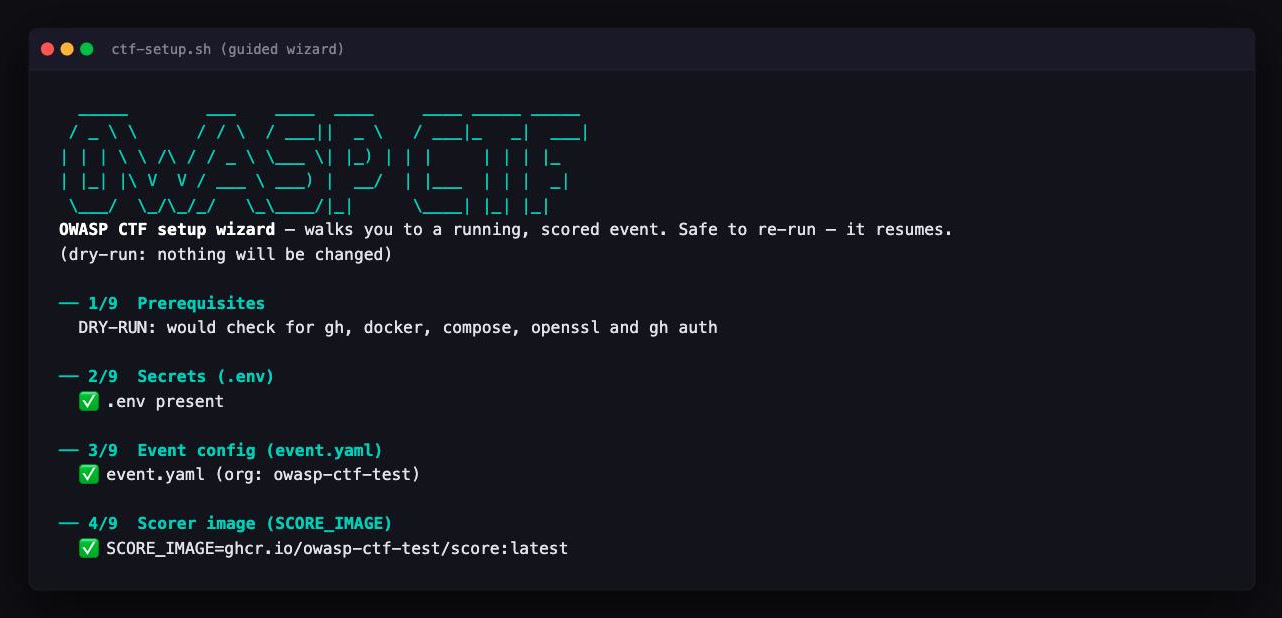
The wizard on a resumed run: every step already done is ticked and skipped, and it continues from the first one still to do. On a first run each of those values is asked for inline, with the GitHub page it comes from.
Step 3, “Event basics”, is the whole of what the wizard writes. Three
keys into .env, in this order:
GITHUB_ORG— the disposable per-event org. Blank is allowed for an event that runs no forked content.ADMIN_LOGINS— comma-separated GitHub logins allowed into/admin. It defaults to the login running the wizard (gh api user), so Enter accepts. An answer that names no usable login is refused, not written. The app parses this string and drops every entry that is not shaped like a GitHub login, so,," , "andalice@example.comall reach it as an empty allowlist — indistinguishable from unset, and/adminthen forbids everyone. How loudly depends on what you got wrong: a non-empty entry that fails the login format makesenvAdminslog ONE warning naming the count of dropped entries and nothing else (never the entries — one might be a pasted secret), once per process, atadmin-auth.ts’s module load; separator-only or whitespace-only input drops nothing and logs nothing at all. Either way the panel is fail-closed and you find out when somebody tries to open it. Give it at least one real login; the wizard anddeploy/fly/deploy.shboth refuse the value outright rather than let it deploy.SCORE_IMAGE, from one question — “Run Secure Development (fork the six targets and score patch PRs)?”. Yes writes the scorer image reference (your existing one, elseghcr.io/<org>/score:latest); no writes it empty. Non-empty is the switch: it is what says this event runs Secure Development at all. Saying yes with no org is refused, since there would be nothing to fork into.
The wizard does not ask how scores reach the box: there is one transport
and nothing selects it (see how scores reach the box).
The SCORE_INGEST key that used to answer that question is gone — the wizard
writes no such line and rewrites none, because nothing reads it. A line an
upgraded .env still carries is inert; doctor points at one whose value is
anything other than poll, since that value describes a transport the box no
longer has, and says to delete it. EVENT_URL is asked once: at step 2 when the wizard
creates .env, or at step 3 when an existing file has no value for it.
Secure Development decides which later steps run. With SCORE_IMAGE set,
steps 4–7 do the scorer image, the sync GitHub App, and the org: forks,
scoring workflows and the package-grant checklist. With it empty each of
those prints ⏭ not needed and the run goes straight to the bring-up — no
scorer image to build, no App to install, no org to create, and a docker
compose --profile app command with no secdev profile. Step 6, the
sign-in OAuth app, always runs: every event needs sign-in. With no event org
it points you at GitHub’s personal new-OAuth-App page instead of the org’s.
The wizard never asks which targets to run: ctf-setup.sh org forks and
provisions all six of setup/targets.tsv for every event that runs Secure
Development, and which of the six contestants actually see is chosen
afterward from /admin → Secure Development → Targets, live, with no
rebuild — see docs/operations.md.
Everything else is a runtime setting, so the wizard does not ask for it.
Which modules run, the event’s name, tagline, location, contact and Discord
invite, the scoring window and dates, hint policy, team caps, the quiz’s
attempt and cooldown knobs: all of them live in ctf:admin:settings and are
changed from /admin while the event is up (config v2, #386). There is no
config file to write or re-bake, and the only “module” question at setup time
is the Secure Development one above, because that module is the only one with
containers and forks to provision.
A resumed run re-reads .env and ticks off what is answered rather than
re-asking it, and says which way the Secure Development switch is set — plus,
when it is off, that setting SCORE_IMAGE is how you turn it on. The one
exception is a hand-rolled .env with no SCORE_IMAGE line at all: that
question has never been put, so the wizard asks step 3 again rather than
assuming an answer.
The wizard closes by offering an optional fly.io deploy (issue #371). After step 9 has verified the box, it asks “Deploy to fly.io now?” — default no, so a run that only wants the local stack ends exactly as it did before. Say yes and it:
- runs
deploy/fly/deploy.sh init --from .env, which asks which Fly region to run in and writes.env.fly; - asks for the public hostname and writes it as
EVENT_URLin.env.flyonly —.envkeeps the compose box’s URL, because one event served from a box and from Fly has two hostnames (ADR 43); - prints the OAuth callback that hostname needs
(
https://<hostname>/api/auth/callback/github). Step 6 registered the callback for.env’s URL, and GitHub matches the callback host exactly, so the Fly deployment needs either that OAuth app repointed at it or a second OAuth app of its own, whose client id/secret go in.env.fly; - previews the deploy with
deploy.sh --dry-runand asks for confirmation before running the real one; - hands off
fly certs add <hostname> --app <app>when the hostname is a custom domain rather than*.fly.dev, andfly ips listfor the case where a deploy reports success but the box is unreachable.
The step skips itself, saying why, whenever it cannot work: no flyctl on
PATH or no Fly session (it prints the install or fly auth login
instruction and moves on), or an app-only event (the Fly machine runs the
scorer and poller too, so deploy.sh requires SCORE_IMAGE).
A failed or abandoned deploy is never fatal: everything the nine
steps wrote to .env stays, and the step names the command to re-run. Under
--dry-run it is narrated and calls nothing. The module itself, and what runs
on the machine, is docs/fly.md.
The rest of this section is the same sequence as explicit commands, for when
you’d rather drive it yourself or script it. Each step is either a
ctf-setup.sh command or a UI-only step GitHub forces you through by hand
(marked below); ctf-setup.sh never mints credentials or creates orgs for you.
# 0. Verify tooling: gh auth, docker, docker compose v2, openssl.
./setup/ctf-setup.sh check
# 1. Clone the repo and work from its root.
git clone https://github.com/dcotelo/owasp-ctf && cd owasp-ctf
# 2. Generate .env — BETTER_AUTH_SECRET, SRH_TOKEN, SCORER_TOKEN, REDIS_PASSWORD,
# EVENT_URL, and empty App/OAuth/SCORE_IMAGE fields to fill later.
./setup/ctf-setup.sh secrets
# 3. Build + push the scorer image, then set SCORE_IMAGE in .env by hand.
# Pin linux/amd64 — GitHub runners are amd64; an arm64 image (the default on
# Apple Silicon) fails scoring with "no matching manifest for linux/amd64".
docker login ghcr.io # token with write:packages
docker buildx build --platform linux/amd64 -t ghcr.io/<your-org>/score:latest --push scorer/
# MANUAL: edit SCORE_IMAGE=ghcr.io/<your-org>/score:latest in .env
# (the wizard builds + pins amd64 for you at step 4)
# 4. Fill in the two bootstrap identities in .env, by hand or with the wizard.
# MANUAL edit: GITHUB_ORG=<your event org>, ADMIN_LOGINS=<your login>.
# Both are read at RUNTIME with no baked default: an empty ADMIN_LOGINS
# 403s everyone at /admin, and an empty GITHUB_ORG leaves the poller
# refusing to start. The event's name and dates, which modules run and
# which Secure Development targets run are all /admin settings — see
# step 10 below.
# 5. Create the disposable GitHub org — UI-ONLY, ctf-setup never creates it:
# https://github.com/account/organizations/new
# 6. Sync GitHub App (poll auth). Opens a pre-filled creation form:
./setup/ctf-setup.sh app-manifest
# UI-ONLY: Create App → Generate a private key (.pem) → note the App ID →
# Install App on the event org. Then wire the key + App ID into .env:
./setup/ctf-setup.sh app-config --app-id <id> --pem ~/Downloads/<app>.private-key.pem
# Add --installation-id <n> to pin the install; otherwise sync
# auto-discovers it at runtime.
# 7. Sign-in OAuth app (separate from the App above). Opens the page and
# prints the exact field values:
./setup/ctf-setup.sh oauth-app
# UI-ONLY: fill the fields with callback <EVENT_URL>/api/auth/callback/github
# → Register → Generate a client secret → copy Client ID + secret. Then:
./setup/ctf-setup.sh oauth-config --client-id <client id>
# The secret is read from a hidden prompt — never on the command line.
# 8. Provision the event org. Dry-run first, then for real:
./setup/ctf-setup.sh org --dry-run
./setup/ctf-setup.sh org
# org forks the targets, creates + protects the `ctf` branch, COMMITS
# ctf-score.yml to each fork, disables inherited workflows, and mirrors
# SCORE_IMAGE into the org's GHCR. Finish the UI-ONLY steps it prints:
# (a) detach each fork from its fork network (Settings → Leave fork
# network);
# (b) keep ghcr.io/<org>/score PRIVATE and grant each fork Read under the
# package's Manage Actions access.
# (There is no secrets step for scoring — the score comment is the whole
# transport. doctor reports any leftover LEADERBOARD_URL/LEADERBOARD_TOKEN
# org secret as a credential to delete.)
# Then verify provisioning:
./setup/ctf-setup.sh doctor
# 9. Bring the containers up. Everything the containers need is in .env —
# there is no config file to bake in. The profiles follow SCORE_IMAGE —
# see "Which profiles do I need?" below; this is the secure-development
# line-up.
docker compose --profile secdev --profile app up -d --build
# 10. Verify: watch the poller heartbeat, open the app, sign in, hit /admin.
docker compose logs -f sync
# Open $EVENT_URL, sign in with GitHub, confirm /admin loads for an admin login.
Prerequisites
Every event needs:
- Docker with Compose v2 (
docker compose versionmust work). ghCLI, authenticated (gh auth login) —ctf-setup.sh checkrequires it whatever the module mix.openssl—ctf-setup.sh checkrequires it (used for secret generation).
Only an event that runs Secure Development (SCORE_IMAGE set in .env)
also needs:
- A GitHub org for the event — one free org per event. It becomes
GITHUB_ORG: the org the forks live in and the poller reads. docker login ghcr.iowith awrite:packagestoken. Theorgsubcommand ends withdocker push ghcr.io/<org>/score:latest, so it needs write access to your own org’s packages.- A scorer image named by
SCORE_IMAGE. Empty means this event does not run Secure Development:ctf-setup orgsays so and skips every fork/mirror/poll step (exit 0 — an app-only event provisions nothing on GitHub and needs no org at all). Set it and the same command provisions all six targets ofsetup/targets.tsv;/adminthen picks the subset contestants see.
Compose is the one place that does not treat empty as “no scorer”: thescorerservice falls back to the privateghcr.io/owasp-ctf/score:latest, so selecting--profile secdevwith noSCORE_IMAGEof your own fails the pull rather than starting anything. Your own image is what makes that profile usable.
Build your own scorer from the engine in scorer/ — that is the
self-contained path and it needs no upstream access:
docker buildx build --platform linux/amd64 -t ghcr.io/<your-org>/score:latest --push scorer/
(--platform linux/amd64 is required — GitHub runners are amd64, and
ctf-setup org’s mirror step refuses a non-amd64 image.)
The upstream image ghcr.io/owasp-ctf/score is private with no formal access
process; if the OWASP-CTF maintainers grant you access, point SCORE_IMAGE at
it instead. Either way ctf-setup org mirrors whatever SCORE_IMAGE names
into your event org so the forks’ Actions can pull it. Authoring a rubric and
building the image is covered in docs/scorer.md.
Fork setup and the contest flow
Each target is a specific upstream app pinned to a source ref — that pin is
the source of truth (there is no middle-man fork). The scorer judges a fork of it
with the vendored rubric, and the scoring baseline image is the stock, unpatched
build that stock-scores-zero proves scores
0 / N:
The per-target upstream repo and pinned ref below are sourced from
setup/targets.tsv, whichctf-setup orgreads to fork each target. Keep this table in sync with that file.
| Target | Upstream repo | Source ref | Scoring baseline (pinned image) |
|---|---|---|---|
juice-shop |
juice-shop/juice-shop |
tag v20.0.0 |
bkimminich/juice-shop:v20.0.0 |
webgoat |
WebGoat/WebGoat |
tag v2025.3 |
webgoat/webgoat:v2025.3 |
vulnerableapp |
SasanLabs/VulnerableApp |
tag 2.1.37 (commit bad68b1) |
sasanlabs/owasp-vulnerableapp:2.1.37 |
securityshepherd |
OWASP/SecurityShepherd |
commit 662771b |
self-build (no stock image) |
dvwa |
digininja/DVWA |
commit d45ba3c |
ghcr.io/digininja/dvwa@sha256:091498ce… |
vampi |
erev0s/VAmPI |
commit f16052d |
erev0s/vampi@sha256:0a5a224b… |
ctf-setup.sh org forks each target into your event org, commits the scoring
workflow (.github/workflows/ctf-score.yml) to each fork’s ctf branch, and
mirrors your SCORE_IMAGE into the org’s GHCR. (The separate render
subcommand writes the workflows to dist/workflows/ for offline inspection
without committing.) It automates the whole per-fork setup, is idempotent (safe to
re-run — each step is skipped once already satisfied), and leaves only three
GitHub-UI-only steps for you to finish by hand. Run ctf-setup.sh doctor
afterward: it prints a status matrix (one row per target, one column per
step) so the whole org’s provisioning is scannable at a glance, then reports
each fork’s scoring-workflow version (see
Upgrading the scoring workflow) and each
fork’s package Read grant, the one step with no API in either direction.
It also checks the three bootstrap facts that have no other alarm:
ADMIN_LOGINS is non-empty (empty 403s everyone at /admin),
GITHUB_ORG is set and matches the org being inspected (a warning
instead of a failure when Secure Development is off, since an app-only event
has no org), and the sync GitHub App is installed on the org, by App
id — failing closed, so a gh error without admin:org scope reports “not
verified” rather than “installed”. See
docs/operations.md.
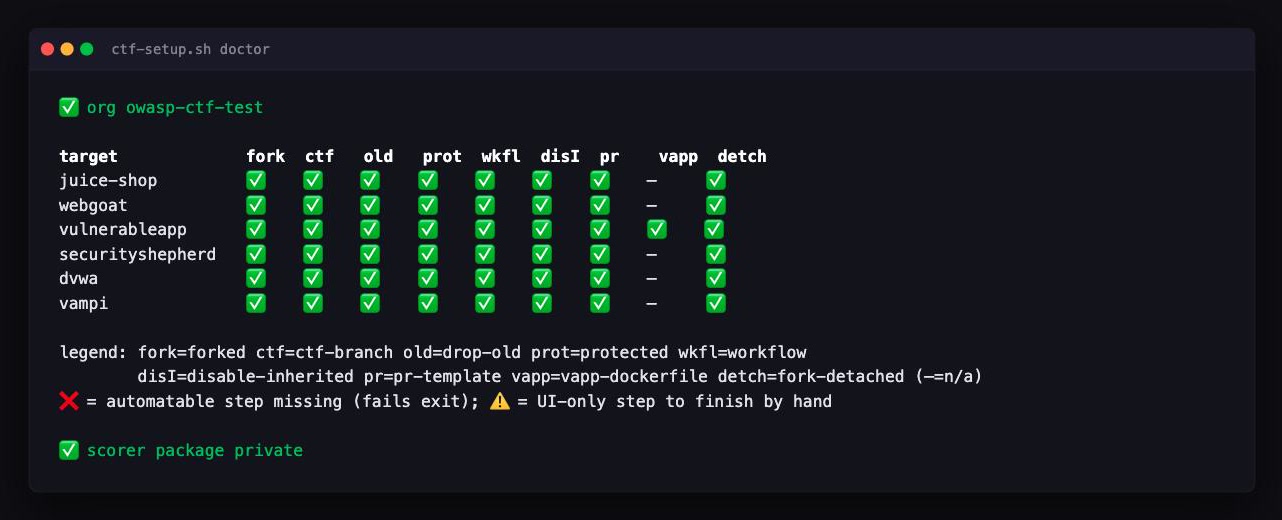
Automated by ctf-setup org (one pass per target):
- Fork the target from its pinned upstream repo/ref into your event org.
- Create and default the
ctfbranch at that pinned ref (and drop the fork’s oldmaster/maindefault branch). -
Protect the
ctfbranch so a contestant can never merge their patch — the PR is scored, not merged. It installs a minimal rule requiring one approving review:gh api -X PUT repos/<org>/<repo>/branches/ctf/protection --input - <<'JSON' { "required_status_checks": null, "enforce_admins": false, "required_pull_request_reviews": { "required_approving_review_count": 1 }, "restrictions": null, "allow_force_pushes": false, "allow_deletions": false } JSON - Install the scoring workflow: renders and commits
.github/workflows/ctf-score.ymlon thectfbranch from the in-repo template. - Disable the fork’s inherited/upstream workflows (everything except
ctf-score.yml), so only the scoring Action runs. - Install the PR template (
.github/PULL_REQUEST_TEMPLATE.md) on thectfbranch. vulnerableapponly — install the Dockerfile it needs to build.- Mirror
SCORE_IMAGEinto the org’s GHCR (once, after all targets), refusing a non-amd64 image so scoring can’t fail at runtime — GitHub runners are amd64; an arm64-only image (e.g. built on Apple Silicon) makes the scoring Action fail withno matching manifest for linux/amd64.
Manual — GitHub UI only, no API to perform them. GitHub has no endpoint to
do these, but doctor confirms the first two by API (their result is
queryable) and shows ✅ once done — only the third is a blind reminder:
- Create the event org itself.
- Detach each fork from the fork network (repo Settings → Leave fork
network, UI-only). This makes the event-org repo a standalone root, so
contestant PRs default to your repo (not upstream) and contestants can
fork it themselves.
doctorverifies via the repo’s.forkflag (✅ detached / ⚠️ still a fork). -
Keep the
ghcr.io/<org>/scorepackage private and grant each fork Read under the package’s Manage Actions access (container visibility is UI-only). The rendered workflow logs in to GHCR with the runnerGITHUB_TOKEN, which the Read grant makes sufficient.doctorverifies the package is private via its.visibility.The per-fork grant has no read endpoint, so
doctorverifies it by observation instead: the rendered workflow pulls the scorer image in its own step (Pull scorer image), anddoctorreads each fork’s recent scoring runs for that step’s outcome — ✅ granted (a run pulled it), ❌ MISSING (a run was refused), or ⚠️ unverified (no run has reached the pull yet). It fails closed: an API error, or anything it cannot read, reports unverified, never granted.This is the only provisioning step with no API, and it used to be the only one whose failure looked like something else — an unpulled image failed inside the scorer step and posted “Scoring did not complete” to the contestant’s PR, so the contestant re-pushed a patch that was never judged while the organizer had no reason to look at the package settings. The workflow now names the cause in the run’s step summary and in the PR comment, and says plainly that it is a setup problem rather than a verdict on the submission.
Already-provisioned forks keep the old workflow until it is re-applied — see Upgrading the scoring workflow below. A fork still on the old one has no
Pull scorer imagestep, sodoctorreports it as ⚠️ unverified — correctly: it has not been observed either way.Note that this includes forks that have scored successfully many times. Under the old workflow the pull happened inside
Run scorer, where it cannot be read back separately, so a working grant is invisible todoctoruntil that fork runs the upgraded workflow once. ⚠️ here means not observed, never not granted. Re-triggering any existing PR on an upgraded fork (close, reopen) is enough to settle it.
Upgrading an event that predates the Redis password
Redis runs with requirepass, and docker-compose.yml reads that password
from REDIS_PASSWORD with :? — so an .env written before this change
does not start a weaker stack, it does not start at all:
error while interpolating services.srh.environment.SRH_CONNECTION_STRING:
required variable REDIS_PASSWORD is missing a value: set REDIS_PASSWORD in
.env (setup/ctf-setup.sh secrets generates one; see docs/hosting.md)
(It names srh rather than redis only because that is the first place
compose resolves the variable — both services need it.)
That is deliberate. A security control whose variable can go missing and
leave the control silently off is the failure this change exists to remove.
doctor flags it before you get there, with a generated value to paste. To
fix it by hand, add one line to .env and bring the stack back up:
echo "REDIS_PASSWORD=$(openssl rand -hex 24)" >> .env
docker compose --profile app up -d # SCORE_IMAGE empty
docker compose --profile secdev --profile app up -d # SCORE_IMAGE set
Pick the line that matches your .env — the same two-way choice as the
bring-up table above. secdev is added iff SCORE_IMAGE is non-empty (a
quiz-, Jeopardy- or AI-only event has no scorer image to pull, and passing the
profile anyway fails at up on the private upstream fallback).
Nothing else changes: no data migration, and the redis-data volume is
untouched. Only redis itself (its requirepass) and srh (its connection
string) are given the password, and only srh can reach Redis — app,
scorer and sync never see it and sit on a separate compose network with no
route to redis:6379 at all.
If you drive Redis by hand (docker compose exec redis redis-cli ...), that
keeps working unchanged: the service sets REDISCLI_AUTH, so redis-cli
authenticates itself inside the container.
Upgrading the scoring workflow
The scoring workflow lives in each fork as a committed file, so a change to
the kit’s template does not reach an event that is already provisioned.
That matters most for the changes you least want stranded — a security fix to
ctf-score.yml would otherwise only reach forks by hand, one at a time.
The rendered workflow carries a version stamp copied from the template:
# ctf-workflow-version: 3
doctor reports every fork’s version against the kit’s, and names the fix
(sample output — the current template version is whatever the stamp above
says in your checkout):
scoring workflow version (template is v3):
  juice-shop         ✅ v3
  dvwa               ❌ v2 — stale (template v3); run: ./setup/ctf-setup.sh upgrade
  webgoat            ❌ pre-versioning — provisioned before workflow stamping; run: ./setup/ctf-setup.sh upgrade
Then re-apply it to exactly the forks that are behind:
./setup/ctf-setup.sh upgrade --dry-run   # see which forks would be touched
./setup/ctf-setup.sh upgrade
upgrade does the workflow step and nothing else. org does it too — its
workflow step compares versions rather than just checking the file exists —
but org also re-mirrors the scorer image, which is a multi-minute push you
do not want between you and a security fix.
Two things worth knowing:
- Open PRs keep their current run. The new workflow applies from each PR’s next push (or a manual re-run), so a mid-event upgrade rolls out as contestants push rather than all at once.
- A fork ahead of your checkout is left alone.
doctorflags it ⚠️ andupgradeskips it — that means your kit is behind, not the fork, and overwriting would silently revert whatever it is running.
Pre-versioning forks (anything provisioned before the stamp existed) read as stale and are upgraded the same way.
The contest flow: a contestant forks your event-org repo into their own
account, patches the vulnerability, and opens a pull request against
<event-org>/<repo>:ctf. The scoring Action (pull_request_target, so a
cross-fork PR gets a writable token to comment) runs the scorer and posts the
score comment; the PR is never merged. Detaching the fork network (manual step
2 above) is what makes this fork-then-PR-back flow work.
How scores reach the box
A Secure Development score travels one way. The fork’s scoring Action judges
the PR and posts the verdict as a comment on it; the sync service polls the
event org’s target repos for those comments and submits what it finds to the
scorer. A score lands on the leaderboard roughly 30 seconds after the Action
finishes. There is nothing to configure and nothing to choose: push ingest —
the Action POSTing the score straight at a /score route on your box — was
removed in v0.6 (#377,
ADR 56),
along with the SCORE_INGEST key that used to select between them. An .env
carried over from an earlier release may still carry that line; nothing reads
it, and ctf-setup.sh doctor names it when it says anything other than
poll.
Two properties come with polling, and they are why it is the only transport.
Nothing has to reach your box from the internet. The one Caddyfile has no
/score route at all, so there is no inbound scoring surface to protect, and
a box behind NAT, on a laptop or on venue wifi scores exactly like a public
one. Only the judge’s own output counts: sync accepts a score marker
only from a comment authored by github-actions[bot], which is a filter a
contestant cannot spoof from their own fork. The whole pipeline is what
scripts/smoke.sh exercises end to end, against a mock GitHub.
All it needs is a GitHub App installed on the event org, so sync has a token
to read those repos with — see Poll auth: GitHub App
below. If your event org still
has LEADERBOARD_URL / LEADERBOARD_TOKEN Actions secrets from a push-mode
event, delete them: nothing reads them any more, and until they are gone they
are standing credentials readable by every run a contestant’s pull request
triggers. ctf-setup.sh doctor tells you whether they are still set.
Which profiles do I need?
Compose profiles follow SCORE_IMAGE, not your taste: app is always on,
and secdev carries everything secure-development needs — the scorer,
which judges PRs against the forked targets, and sync, which brings their
scores back. Both services carry profiles: ["secdev"], so they come up
together or not at all. A quiz-only event must not be asked to pull a scorer
image it has no reason to own.
Profiles and SCORE_IMAGE are two separate choices that have to agree, not
one setting picking both. You choose the profile at up: --profile app
alone for a quiz/classic/ai-only event, --profile secdev --profile app with
Secure Development. That second line needs an accessible SCORE_IMAGE — the
compose fallback image is private, so bringing secdev up without your own
SCORE_IMAGE set fails the pull. Separately, the app’s
DEFAULT module set (what an organizer sees on first opening /admin, and
the outage fallback) follows SCORE_IMAGE on its own: Secure Development
alone when it is set, nothing when it is not — Quiz, Jeopardy and AI are
switched on from the panel (#386). Nothing enforces that the two agree, so
keep them in sync yourself: never bring the secdev profile up without a
SCORE_IMAGE, or the scorer container has nothing to score against.
Nothing is baked into the images any more (#386): --build only rebuilds
the code, and every value the containers need — ADMIN_LOGINS,
GITHUB_ORG, SCORE_IMAGE — is read from .env when they
start. Pick the command by what that file says:
| Your event | Command |
|---|---|
Secure Development (SCORE_IMAGE set) |
docker compose --profile secdev --profile app up -d --build |
No Secure Development (SCORE_IMAGE empty) — quiz and/or classic and/or ai |
docker compose --profile app up -d --build |
Quiz, Jeopardy and AI need no profile of their own: they are app-side modules,
they run inside the app container, and an organizer switches them on from
/admin at any time without touching compose. ctf-setup.sh wizard prints
(and offers to run) the right line for the .env you answered into, so you do
not have to pick by hand.
Prefer the cloud over your own machine? Deploy on AWS ships a
Terraform module for an ECS Fargate stack behind an ALB, over managed
ElastiCache — terraform apply up, terraform destroy down. It replaced a
single-EC2 deploy, so an existing box upgrades by migration rather than by
apply.
Poll auth: GitHub App
sync needs a token to read the event org’s target repos, and a GitHub App
is the only supported poll auth: org-scoped, auto-expiring, revocable, and not
tied to a person. Each organizer creates their own App from
sync/app-manifest.json
and installs it on their event org — there is no shared, central App, so the
private key stays yours.
ctf-setup.sh assists the two error-prone parts; you still click Create and
Install in GitHub’s UI (the script cannot mint credentials for you):
# 1. Open a pre-filled App-creation form against your event org.
ctf-setup.sh app-manifest
#    In the browser: Create the App, "Generate a private key" (downloads a
#    .pem), note the App ID, then "Install App" on the event org.

# 2. Wire the downloaded key + App ID into .env (base64-encodes the PEM).
ctf-setup.sh app-config --app-id <id> --pem ~/Downloads/<app>.private-key.pem
#    Add --installation-id <n> to pin the install; otherwise sync
#    auto-discovers it at runtime.
This sets GITHUB_APP_ID / GITHUB_APP_PRIVATE_KEY (base64-encoded PEM) and,
optionally, GITHUB_APP_INSTALLATION_ID in .env. Both GITHUB_APP_ID and
GITHUB_APP_PRIVATE_KEY are required — sync refuses to start without them.
You can also set all three by hand instead of using the helpers.
GitHub OAuth app
Contestants (and admins) sign in with GitHub, so you need an OAuth app — separate from the sync GitHub App above. OAuth apps have no manifest/create API, so this is a guided flow rather than an auto-filled one:
# 1. Open GitHub's new-OAuth-App page for the event org and print the exact
#    field values to paste (callback = <EVENT_URL>/api/auth/callback/github).
ctf-setup.sh oauth-app
#    In the browser: fill the printed fields, Register, then "Generate a new
#    client secret" and copy the Client ID + secret.

# 2. Wire them into .env. The secret is read from a hidden prompt — never on
#    the command line or in shell history.
ctf-setup.sh oauth-config --client-id <client id>
This sets GITHUB_CLIENT_ID and GITHUB_CLIENT_SECRET in .env; the app
reads them at runtime. EVENT_URL in .env is the event URL — Caddy, the app’s
auth flow, the HTTPS start-up guard, the CSRF origin check and the leaderboard
link in every fork’s score comment all read it, and nothing else carries a
second copy. The deleted config file used to carry a url: field beside it;
it was a deployment fact living in an event file, it disagreed silently, and
it is gone (ADR 43).
You can also set both by hand instead of using the helpers, and you may
register the OAuth app on your personal account rather than the org.
Use HTTPS for any real event. Set
EVENT_URLtohttps://<your-domain>(nothttp://) for anything beyond local testing. Caddy auto-provisions TLS for a real domain, and the sign-in session cookie is only markedSecurewhen the URL is HTTPS — over plainhttp://the session cookie can be sniffed on the wire, which for an organizer login means admin takeover.http://localhostis fine for a local trial only.This is enforced, not just advised. A production start with an
http://EVENT_URLpointing at anything other than loopback fails the startup check inapps/web/src/instrumentation.ts: theappcontainer comes up but answers500to every request, and the first lines ofdocker compose logs appname the variable, the value, and the fix. The check runs at server start only —pnpm buildis unaffected, so a build machine needs no event config.If a deployment is deliberately TLS-less (a closed lab, an isolated classroom network) set
ALLOW_INSECURE_EVENT_URL=1. It downgrades the refusal to a startup warning that says sessions on that deployment are sniffable by design. It is not for TLS terminated upstream — in that setup the public URL is stillhttps://, soEVENT_URLshould sayhttps://and the check passes on its own.
Monitoring
The box exposes two health endpoints, for two different watchers. Both are
public and unauthenticated (a free uptime tier cannot present a credential),
and both live under the same disclosure rule: nothing in either payload that
git log and the tag list do not already tell you.
GET /health— liveness plus the build stamp:{status, version, revision, builtAt}. Answers 200 whenever the Node process is serving requests and depends on nothing else. This is what Fly’s machine check watches (deploy/fly/fly.toml,[[http_service.checks]]), and it must stay that way: a check that failed on a Redis blip would restart the one machine over the blip.GET /health/deep— can this box actually score? Probes Redis through srh (PING) and, whenSCORE_IMAGEis set, the scorer’s own/healthz; answers 200 when both are up and 503 the moment either is not, with each dependency reported as exactly"ok"or"down"— never the reason, host or URL (those go to the server log). It also reports the sync poller’s last poll time and its age in seconds, for information only: a quiet poller never fails the check. A box with no scorer image omitsscorerandsyncentirely rather than vouching for a service it does not run. Results are cached in-process for 10 seconds, so the unauthenticated URL cannot be turned into a probe storm.
Point an external monitor at /health/deep. Any free uptime service
works (UptimeRobot, Better Stack, Healthchecks.io — none of them needs a
header): HTTP monitor on <EVENT_URL>/health/deep, every 1–5
minutes, alert on any non-200, with a Discord webhook as the notification
channel since the event already runs on Discord. Optionally match the keyword
"status":"ok" so a 200 that somehow carries the wrong body still alerts.
This is the one alarm for the failure this kit is designed to hide from
contestants — every read fails open, so a dead Redis or scorer leaves the site
rendering with nothing scoring — and without it the first person to notice is
a contestant asking why the board stopped moving.
The monitor’s poll will also wake a machine that has idle-suspended. During
an event that must not be a factor at all: set FLY_AUTO_STOP=off in
.env.fly and redeploy before it starts (see
docs/fly.md); deploy.sh prints the same warning.
Cloudflare in front of the box
The reference deployment’s domain is on Cloudflare DNS with the proxy on
(“orange cloud”), so every request reaches Fly through Cloudflare’s edge — a
cf-ray header on any response is how you can tell. That is the only place
a trustworthy per-IP control can live: the app never sees a client
address it can rely on (Fly sees Cloudflare’s, and the x-forwarded-for
value a caller can set is appended to, not replaced), and the app’s own
rate limiter is per login, which starts only after sign-in. An
unauthenticated curl loop against /api/* therefore still costs the box a
session lookup per hit unless the edge stops it.
One rate-limiting rule, on the Free plan. Cloudflare’s Free plan includes exactly one rate-limiting rule, counted by IP over a 10-second window with a Block action. Create it at the zone level (pick the domain, then Security → Security rules → Create rule → Rate limiting rule — not the account-level WAF page, which is a paid add-on):
| field | value |
|---|---|
| When incoming requests match | URI Path · starts with · /api/ |
| Same characteristics | IP |
| Rate | 100 requests per 10 seconds |
| Action | Block, 10 seconds |
/leaderboard and ?display=1 are not under /api/, so the projector
board’s 30 s refresh and a room full of people reloading the standings are
never counted; sign-in goes through /api/auth/*, and no person clicks that
ten times a second. Verified on the reference box with a side-effect-free
probe — GET on a deliberately nonexistent path such as
/api/rate-probe, which answers 404 and touches no store; never a POST
to a submit, answer, hint or gate route, which would spend cooldowns,
attempt caps or hint budgets — from one address: 130 requests in about three
seconds let 115 through and blocked 15 with 429, the block lifted after
ten seconds, and /leaderboard answered 200 throughout.
This is the layer above the app’s own controls, not a replacement for them:
per-item cooldowns and the quiz attempt cap stop guessing (they run inside
the grading scripts); the per-login limiter stops one account hammering team
join and hint reveal; the pre-event password gate (POST /api/gate) has its
own best-effort throttle keyed on the first x-forwarded-for value, which a
caller can spoof for a fresh bucket — it slows a casual guesser, and that is
all it claims; Cloudflare stops gross floods before they reach the box.
Issue #438 tracks the per-login buckets still missing on the two submit
routes and an Insights view of throttled logins.
Configuration
There is no configuration file. Since #386 an event is configured in
exactly two places, and the split between them is the whole design: what a box
needs before it can answer its first request lives in .env, and everything
an organizer changes while the event runs lives in Redis behind /admin.
| Plane | Where | Who writes it | What lives there |
|---|---|---|---|
| Bootstrap — facts the containers need at start | .env |
the wizard, or you, once per deployment | GITHUB_ORG, ADMIN_LOGINS, SCORE_IMAGE, EVENT_URL, and the secrets |
| Runtime — everything an organizer tunes during the event | the ctf:admin:settings hash in Redis |
/admin, live |
which modules run, which Secure Development targets run, the event’s identity, the scoring schedule, freeze, hint policy, team caps |
Bootstrap keys are read at container start, not at build: changing one is
an .env edit plus a restart, never a rebuild. Runtime settings are read on
every request and take effect immediately, with no restart at all. See
ADR 55
for why the old baked config file was retired.
The four bootstrap keys
Everything else in .env is a secret or a wiring detail (see
Environment variables for the complete list). These
four are the event’s identity to the machine:
| Key | Required | What it drives | Empty or unset means |
|---|---|---|---|
ADMIN_LOGINS |
yes | Comma-separated GitHub logins (matched case-insensitively) allowed into /admin. Read by lib/bootstrap-env.ts at start, and parsed by parseAdminLogins: entries are trimmed and any that is not shaped like a GitHub login is dropped. So a value of separators only (,), whitespace only, or nothing but invalid entries (an email address, say) parses to the SAME empty allowlist as unset. Set at least one valid login and check the parsed list is not empty. |
Nobody is an admin — /admin 403s every login, including yours. This fails CLOSED on purpose; there is no “no allowlist, let everyone in” state. |
GITHUB_ORG |
when running Secure Development | The event org contestants fork the target repos under. Drives every fork link the app renders, the policy-page prose, and the repos sync polls. |
The app renders a plain repo name instead of a broken link, and sync refuses to start at all, logging ctf-sync: GITHUB_ORG is not set. |
SCORE_IMAGE |
when running Secure Development | Your scorer image, built from scorer/ and pushed somewhere the box and the forks can pull it. |
The event does not run Secure Development — see below. |
EVENT_URL |
yes | The event URL: Caddy’s TLS host, the auth callback origin, the HTTPS start-up guard, the CSRF origin check, and the leaderboard link in every score comment (ADR 43). | Defaults to http://localhost, which is fine only for a local trial. |
SCORE_IMAGE is how a box says whether it runs Secure Development. It is
not just “which image to pull”: it is the one setup-time fact left about that
module, and three things read it as the answer.
- The compose profile.
scripts/dev-stackand Fly’sdeploy/fly/render-compose.shadd--profile secdeviffSCORE_IMAGEis non-empty — the one place the question is answered atuptime, and derived rather than a second knob to drift (the lesson of #372/#374). - The default module set. On a first boot against an empty Redis — and as
the fail-open answer when the settings read fails — a box with
SCORE_IMAGEset enablessecure-developmentand nothing else; a box without it enables nothing, and the landing page renders its explicit no-boards state pointing at/admin. - The admin toggle. With
SCORE_IMAGEempty,/admin’s Secure Development switch is disabled with that reason named — there would be no scorer container for it to talk to.
ctf-setup.sh reads it the same way: with no SCORE_IMAGE it skips every
fork, mirror and poll step instead of failing.
What /admin owns
Everything below is a runtime setting in ctf:admin:settings, changed from the
panel while the event is running, and covered in
docs/operations.md:
- Which modules run — Event → Modules. Quiz, Jeopardy and AI are switched on
and off live; so is Secure Development, whenever
SCORE_IMAGEis set. - Which Secure Development targets run — Secure Development → Targets. The
setup script forks and provisions all six; the panel picks the live subset,
and
syncre-reads it every tick. - The event’s identity — Event → Identity: name (default
OWASP CTF), tagline, location, contact e-mail, Discord invite. - The scoring schedule and the freeze — Event → Schedule: scoring opens, scoring closes, and the manual pause.
- Hints, teams and caps — the hint switch and prices, the registration window, and players per team.
- Module content — quiz questions, Jeopardy challenges and flags, AI challenges: all authored in the panel, all exportable through the event archive.
None of it needs a restart, a rebuild, or an edit on the box.
Modules: registration is code, enablement is runtime
Four module ids are registered today — secure-development, quiz, classic
and ai. Registration is deliberately static (ADR 35): a module id exists
because the kit ships code for it — apps/web/src/lib/modules.ts’s ModuleId
union and its registry are the whole list. There is no config-file namespace to
add one to and no dynamic discovery; see
docs/modules.md for what a new module has to provide.
Enablement is entirely runtime. Every app image ships the routes, nav
entries and admin tabs for all four, so switching one on in /admin → Event →
Modules takes effect on the next request, and switching it off hides it the
same way. Nothing about which modules run is decided at build time any more,
and nothing about it is decided in .env — except that SCORE_IMAGE decides
whether Secure Development can be switched on at all, because that module is
the only one with containers of its own.
Enabling a module changes the landing page, not just the nav: the
platform frame (event name, dates, countdown, CTAs, Discord link, progress
card) stays the same, but each enabled module contributes its own tagline,
hero paragraph, “what to expect” section and steps, so the home page always
describes exactly the modules an event actually runs — a quiz-only event
never advertises forking a target or opening a PR. See
docs/modules.md §5 for the home
block contract.
secure-development is not required — a single module is enough to run an
event. ctf-setup.sh’s org/render/doctor each skip fork-based
provisioning and report “nothing to provision/check” instead of failing when
no SCORE_IMAGE is set, and sync is simply never started. A quiz-only event
is therefore a supported event on its own: /challenges 404s (that route
doesn’t exist without the module that owns it), and /how-to-play, /rules,
the landing page, the leaderboard, and /profile all compose from whatever
modules are enabled instead of assuming secure-development is one of
them. See docs/modules.md §5 for
the UI composition contract and ADR 55
for where module registration and enablement live now — the app’s registry and
the /admin settings, with SCORE_IMAGE as the one switch Secure Development
answers to. ADR 24
records why an unconfigured module is tolerated while an unknown one is not.
Boot a quiz-only event with docker compose --profile app up -d --build
— just the app profile, and no build-args at all. Secure Development’s
profile (secdev) carries that module’s two services, sync and the
scorer, and a quiz-only event has no use for either: nothing to poll, and no scorer image to pull
(the compose fallback is the maintainers’ private image, so asking for it
fails the bring-up). See the profiles table
above.
If you do pass --profile secdev anyway — say you enabled
secure-development mid-event and then dropped it again — sync polls the
org in .env, or refuses to start at all if GITHUB_ORG is empty, logging
ctf-sync: GITHUB_ORG is not set and exiting non-zero
(sync/src/index.js’s main()); docker-compose.yml’s sync service is
restart: on-failure, so that refusal repeats in the log until the key is
set. You still need a SCORE_IMAGE for the scorer that profile also brings
up.
Hints and teams have no bootstrap knob
Neither is an .env key: team size is the /admin Event tab’s “players per
team” knob, and hints have exactly one switch: /admin’s hint controls, a
runtime override stored in Redis (ADR 31). It is live, survives restarts,
and governs everything — whether a hint can be bought, whether the challenges
page offers the button, and whether the leaderboard shows hint penalties. There
is no environment variable and no rebuild involved; see
docs/operations.md.
The one thing an organizer setting cannot do is turn hints on without
UPSTASH_REDIS_REST_* credentials — hint text lives only in Upstash, so
without them there is nothing to reveal. What a
module must provide to
plug in — scoring contract, the score transport, security requirements,
provisioning — is documented in docs/modules.md.
Changing a setting after the stack is running
| What you changed | What it takes |
|---|---|
Anything in /admin — modules, targets, identity, schedule, hints, teams, content |
Nothing. It is live on the next request. |
ADMIN_LOGINS, GITHUB_ORG, EVENT_URL, a secret |
Edit .env, then bring the stack back up with the same profiles the table above gives for your event — --profile app with no SCORE_IMAGE, --profile secdev --profile app with one — to recreate the containers with the new environment. No rebuild in any case. |
SCORE_IMAGE (adding or dropping Secure Development’s containers) |
Edit .env, then bring the stack up with the profiles that now match it: --profile secdev --profile app once it is set, --profile app alone once it is empty. |
| The app’s own code (a kit upgrade) | docker compose --profile app build app, then up -d. |
The contestant app (apps/web/, vendored — see
apps/web/VENDORED.md)
reads no build-time configuration at all, and no image in the kit takes a
config build-arg. That is the point of #386: an image is the same image on
every box, and a build that forgot a variable can no longer ship an event with
an empty admin list. Dates come from the scoring schedule (Scoring opens /
Scoring closes) set in /admin → Event, same as name, tagline, location,
contact e-mail and Discord invite — all runtime settings, read on every
request.
Environment variables
.env is what docker-compose.yml interpolates; each service then reads its
own environment. A variable reaches a container only if docker-compose.yml
passes it — setting one that compose does not forward does nothing, silently
(that is why ALLOW_INSECURE_EVENT_URL and the gate pair are wired through
explicitly). Rows marked override are knobs compose does not forward; reach
them with a docker-compose.override.yml, or on Fly through .env.fly. Rows
marked fixed are values compose sets itself and you do not set at all.
setup/ctf-setup.sh secrets generates the required ones (.env.example is
the same list, annotated), and doctor flags a missing REDIS_PASSWORD.
Compose bring-up — read by compose at up, before any service starts:
| Variable | Read by | Default | Meaning |
|---|---|---|---|
REDIS_PASSWORD |
redis, srh |
required (:?) |
Redis requirepass. Unset or empty fails up at interpolation rather than starting an open Redis; only srh can reach redis:6379. |
SRH_TOKEN |
srh; app/scorer/sync as UPSTASH_REDIS_REST_TOKEN |
required | Bearer token in front of the Redis REST proxy every service talks to. |
SCORE_IMAGE |
scorer image; scripts/dev-stack and deploy/fly/render-compose.sh as the secdev switch |
ghcr.io/owasp-ctf/score:latest (private) |
Your scorer image built from scorer/. Non-empty is what makes Secure Development available: it adds the secdev profile, seeds the first-boot default module set, and permits the /admin toggle (enabledModules still decides what is live). Empty and ctf-setup org skips every fork/mirror/poll step instead of failing; non-empty and it provisions all six targets. |
EVENT_URL |
caddy as EVENT_HOST; app as BETTER_AUTH_URL |
http://localhost |
The event URL — TLS host, auth callback origin, HTTPS start-up guard, CSRF origin check. https:// for any real event. |
REDIS_DIR |
redis |
/data |
Where the append-only file lives inside the volume. Fly sets /data/redis (one volume per machine, see docs/fly.md). |
STATE_PATH |
sync |
/state/state.json |
The poller’s cursor file. Fly sets /data/sync/state.json. |
EVENT_HOST, SRH_MODE, REDISCLI_AUTH |
caddy, srh, redis |
fixed | Derived by compose: Caddy’s host from EVENT_URL, srh’s config mode (env), redis-cli’s password from REDIS_PASSWORD so docker compose exec redis redis-cli authenticates itself. |
App (apps/web, runtime unless noted):
| Variable | Read by | Default | Meaning |
|---|---|---|---|
BETTER_AUTH_SECRET |
lib/auth.ts, lib/gate.ts |
required | Session-signing secret; also keys the pre-event gate cookie’s HMAC. |
GITHUB_CLIENT_ID, GITHUB_CLIENT_SECRET |
lib/auth.ts |
required | The sign-in OAuth app (not the poll GitHub App). |
ALLOW_INSECURE_EVENT_URL |
instrumentation.ts |
unset | 1 downgrades the http:// non-loopback refusal to a start-up warning. TLS-less closed networks only. |
CHALLENGES_GATE_ENABLED, CHALLENGES_GATE_PASSWORD |
lib/gate.ts |
unset | Pre-event shared-password gate over the module pages: true plus a password. A half-configured gate stays open. |
LEADERBOARD_SOURCE |
lib/leaderboard/source.ts |
fixed: lambda |
mock / lambda / upstash. With secure-development disabled the mode is forced to empty (no scorer read; the board is built from the module overlays alone); an unknown value falls back to mock with a warning. |
LEADERBOARD_API_URL |
lib/challenges.ts, lib/leaderboard/lambda.ts |
fixed: http://scorer:4000 |
Scorer base URL for the challenge catalogue and the board. |
UPSTASH_REDIS_REST_URL, UPSTASH_REDIS_REST_TOKEN |
lib/upstash.ts; also scorer/src/store.js, sync/src/redis.js |
fixed: http://srh:80, SRH_TOKEN |
Redis-over-REST endpoint. Hints, teams, admin settings and module content live behind it. |
TEAM_WRITES_ENABLED |
lib/team-store.ts |
fixed: "true" |
Enables team create/join writes; off in mock mode. |
GITHUB_ORG |
lib/bootstrap-env.ts |
empty | The GitHub org contestants fork the target repos under; drives fork links and policy-page prose. Empty renders plain repo-name text, never a broken link. |
ADMIN_LOGINS |
lib/bootstrap-env.ts, lib/admin-auth.ts |
empty | Comma-separated GitHub logins (case-insensitive) allowed into /admin. Empty means nobody — and so does a value that parses to nobody: unparseable entries are dropped, so separators-only, whitespace-only and invalid-only all mean the same 403 for everyone. Changing it needs an env edit and a restart. |
Sync (sync/src/config.js):
| Variable | Read by | Default | Meaning |
|---|---|---|---|
GITHUB_ORG |
sync |
required | The event org whose forked target repos are polled. sync refuses to start without it, logging ctf-sync: GITHUB_ORG is not set — for the poller a missing org is a misconfiguration, not “nothing to poll”. Which targets inside the org are polled is a runtime /admin setting sync re-reads every tick. |
GITHUB_APP_ID, GITHUB_APP_PRIVATE_KEY |
sync |
required | The poll GitHub App; the key is base64-encoded PEM. sync refuses to start without both. |
GITHUB_APP_INSTALLATION_ID |
sync |
auto-discovered | Pin the installation when the App has more than one. |
SCORER_TOKEN |
sync; scorer as CTF_SCORE_BEARER_TOKEN |
required | Bearer token sync presents to POST /score. |
SCORER_URL |
sync |
fixed: http://scorer:4000 |
Where scores are submitted. |
POLL_INTERVAL_MS |
sync |
30000 |
override. Integer in 1..1789569705 (floor((2^31-1)/1.2), headroom for the +20% jitter); anything else refuses at boot rather than tight-looping. |
GITHUB_API_URL |
sync |
https://api.github.com |
override. scripts/smoke.sh points it at mock-github. |
COMMENT_AUTHOR |
sync |
github-actions[bot] |
override. The only login whose <!-- ctf-score --> markers are ingested as points. |
Scorer, score serve (scorer/src/serve.js, on the box):
| Variable | Read by | Default | Meaning |
|---|---|---|---|
CTF_SCORE_BEARER_TOKEN |
serve.js |
fixed: SCORER_TOKEN |
Bearer auth on POST /score; falls back to SCORER_TOKEN, refuses to start with neither. |
PORT |
serve.js |
4000 |
override. Checked lexically, integer 0..65535; a malformed value refuses rather than binding an ephemeral port. |
RUBRIC_DIR |
rubric.js (serve and judge) |
/rubric (image build arg RUBRIC_DIR=rubric.owasp) |
The rubric baked into the image — see docs/scorer.md. |
UPSTASH_REDIS_REST_URL |
serve.js, store.js |
fixed: http://srh:80 |
Redis store when set, in-memory store when unset. |
Scorer, score judge (scorer/src/judge.js, exec.js) — runs inside the
fork’s Action, so these come from the rendered ctf-score.yml, org Actions
secrets/variables, or scripts/acceptance-scorer.sh, never from .env:
| Variable | Read by | Default | Meaning |
|---|---|---|---|
CTF_OUT_DIR |
judge.js, entrypoint.sh |
GITHUB_WORKSPACE |
Where ctf-score.md is written. The workflow sets /ctf-out, outside the PR checkout — the marker in it is trust-authoritative. |
CTF_DISCLOSE_TABLE |
judge.js |
disclose | 0 / false / no hides the per-challenge table in the PR comment (progress bar and counts always show). An org Actions variable. |
APP_READY_TRIES, APP_READY_DELAY |
judge.js |
60, 5 (seconds) |
Readiness probe before judging. A literal 0 skips it — only a bring-up script that already proved the app up should set that (securityshepherd.sh does). |
CTF_SCORE_SAFETY_MS |
exec.js |
30000 |
Per-probe kill timeout, ms; values below 1 fall back to the default. |
CTF_SCORE_CONCURRENCY |
exec.js |
per-target default | Overrides the probe pool width (clamped to 1..itemCount). |
CTF_UPSTREAM_DIR |
judge.js |
GITHUB_WORKSPACE |
Source tree for the static probes that read the contestant’s code instead of HTTP. |
Target bring-up scripts (scorer/entrypoints/*.sh, sourced by the judge’s
entrypoint.sh; TARGET and APP_URL are the required inputs, set by the
workflow):
| Variable | Read by | Default | Meaning |
|---|---|---|---|
WEBGOAT_JDK_IMAGE |
webgoat.sh |
eclipse-temurin:23-jdk-noble |
JDK used to build a fork from source through its own ./mvnw. |
SS_UPSTREAM_REPO, SS_UPSTREAM_REF |
securityshepherd.sh |
OWASP/SecurityShepherd @ 662771b… |
Source cloned when the workspace has none. Pinned to a commit, never a branch. |
WEBWOLF_URL, WEBGOAT_LEAKED_ADMIN_PW, WEBGOAT_DESER_PAYLOAD |
exported by webgoat.sh, read by the WebGoat rubric’s tests |
computed | Not inputs: the bring-up derives them from the running container and always exports them (an empty payload means “patched”, an absent one would fail two challenges outright). |
<TARGET>_UPSTREAM_REPO, <TARGET>_UPSTREAM_REF |
scripts/acceptance-patched.sh (JS_, DVWA_, WEBGOAT_, VULNERABLEAPP_, VAMPI_, SS_), scripts/acceptance-target.sh (WG_) |
pinned per script | Local acceptance only: which fork and ref to judge as the patched or stock baseline. |